

How To Repair Rotted Subfloor
Are your joists rotten? In need of fixing? Unsure where to start or what to look for?
In this guide yous volition learn:
- Common signs & Causes of Rotten floor joists,
- How to Repair or Supercede Rotten Floor joists in your habitation,
- How to repair joists underneath bathtubs and in crawlspaces as well equally Forestall them from rotting in the Future.
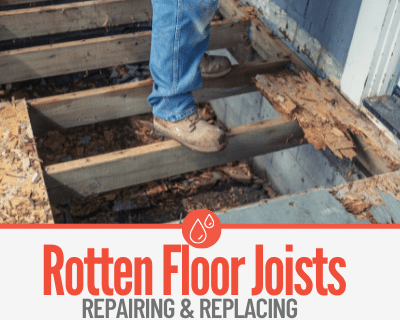
How To Tell If Your Floor Joists Are Rotten
A unproblematic visual inspection should tell you if your joists are rotten.
However, floor joists are frequently covered upwards by floors and ceilings and hidden away in crawlspaces. This means that you might want to look for other common signs of failing h2o damaged joists earlier tearing your floors up!
Common signs and symptoms of rotten/failing joists include:
- Floors that are uneven or get-go to sag
- Dysfunctional or croaky doors and windows
- Visible presence of mold, allergens, or odors
- Large blotchy stains on floors or ceilings
- Unusually high levels of condensation inside the home
- Termite and/or pest issues
If your dwelling house is experiencing these symptoms: it's time for a visual and physical inspection of your joists.
Wet Rot
"Wet" rot is a blazon of fungus that grows when woods becomes saturated with h2o over a menstruation of time.Moisture rot in joists volition usually occur when there is a serious plumbing leak or in a alluvion situation.
Moisture Rot most of the times volition exist much harder to notice due to the fungus mostly growing inside the flooring joists.
Signs of Wet Rot:
- A dark brownish colour of your floor joists
- Large joist discolorations or "wet" spots
- Possible black mucus on the Joists
- Joists volition be soft and Crumbly
Dry Rot
"Dry" rot is another very unsafe and destructive mucus. Unlike information technology'due south namesake though, dry rot only occurs when forest is exposed to loftier moisture levels. Appropriately dry out wood will not experience "dry" rot.
This blazon of mucus unremarkably takes over the joists over a longer period of time primarily due to condensation, moisture build-up in the floor structure, and poor ventilation of joists.
Dry rot also spreads rapidly to other wood, crosses brick and mortar surfaces, and causes an increase in interior condensation levels by itself. Dry out rot can exist a very serious threat to the structural integrity of non only your joists but too your whole house.
Signs of Dry Rot:
- White fuzzy mold on the surface of the forest
- Very breakable wood
- Possible Condensation on interior windows
- Apparant Mold issues
Annotation: Dry rot infestations can spread rapidly and should be taken as a very serious threat to the condom of a home.

Common Causes Of Rotten Flooring Joists
Flooring joists usually become rotten for i or more of the following (but preventable) reasons:
one.Exposure To Water Leaks
Damage to leaky pipes (and/or flooding) is a primary crusade for rotten joists. Fortunately, most wood dries out quickly.
The real issue many homeowners overlook: slowly leaking pipes and/or fixtures.
These small leaks tin can get unnoticed for long periods of time and cause serious rot infestations in the meantime. Whole firm water meters and/or leak detectors are a great way to check for and prevent this simple issue.
two.Wet Build-Up
All houses are congenital to withstand a certain corporeality of natural condensation moisture throughput.
Unfortunately, some houses suffer from this effect more than than others. If an surface area of a domicile doesn't take proper ventilation, rotting timber is an inevitable event.
Basements and crawlspaces are especially vulnerable in this regard. As a homeowner, it is imperative to ensure that ventilation paths to these areas are properly installed, unblocked, and operation properly.
three.Sideways Penetration
Occasionally, physical foundations wind up absorbing excess h2o. This water then finds it ways into the floor joists that rest directly on the foundation walls/runners.
This is called "sideways penetration," and it is the reason why floor joists oft rot at the ends before rotting in the middle. To preclude this result – bank check into properly grading and/or waterproofing your foundation.
And don't forget to check the ends of your joists for rot!
iv.Rise Damp
This is an effect that is far more common in older homes with stone or brick/mortar foundations. Strangely enough, water can actually flow up through brick and/or mortar, and find it'south way into floor joists and walls.
This issue is less common in modern homes, but it's still worth checking for if your home is synthetic in this mode.
H2o Damaged & Rotten Floor Joists?
Call 844-994-1288 for a Hazard Gratis guess from a Licensed H2o Harm Restoration Specialist in your area.
We Can Help Assess the State of affairs & Repair/Replace your Rotten Floor Joists.
Can You Replace Rotten Floor Joists?
Yep, y'all can supercede rotten floor joists in your dwelling house.
In fact, this is ordinarily a much better option in the long run than repairing/sistering. Doing so, even so, is usually a complex and fourth dimension-consuming process.
Please encounter beneath for more details on how to do this.
Here's when to Repair Or Replace your Rotten Flooring Joists
Most professionals use a elementary rule of pollex when making this conclusion. If the rotten area of your joist(due south) is larger than six inches across: you demand to either supervene upon the joist completely or "sister" it from terminate-to-cease (or with meaning overlap).
For large rot infestations, and for sections of floor where multiple joists take been affected, it will exist necessary to completely supplant the joists.
It is commonly best to call a professional for this, for many reasons.
However, there are times when it is adequate to replace a rotten floor joist on your own. DIY repairs are possible:
- If the joist does non support a load-begetting internal wall.
- If the rot infestation is contained to a specific location or specific joist.
- If it is possible to admission both ends of the joist without compromising structural integrity.
- If the homeowner has the proper tools, knowledge, hardware, and lumber to complete the job likewise as the confidence to accomplish the joist replacement safely.
"Sistering" is the process of bolting another joist to the original in a side-by-side configuration. The joists then function equally a single unit with the strength of the second joist added to the original.
For the purposes of this article, we use the term "repair" in identify of "sistering." In other words, when nosotros talk almost "repairing" a joist: we really mean that we're "sistering" it.
Safety Note: "Sistering" is a complex procedure. The person doing information technology needs to understand bones structural applied science concepts:
- Which fixtures to use (carriage bolts, lag screws, epoxy, etc)
- How many of such to utilise and where to place them (this differs greatly for various joist types)
- The corporeality of weight sitting on the particular joist(s)
- How to properly jack upward the floor while performing the repair
- Whether or not the rot has been dealt with properly
- How much of an overlap is needed
… and so on and and so forth.
As such… we practise not cover how to 'properly' sister specific joist types in this article. Instead, we're listing the steps for the process every bit a whole, forth with general tips and advice.
How To Repair Rotten Floor Joists
1.Fix the Moisture Source
The first pace is to prepare the source of moisture and/or water damage that is causing the rot infestation.
Tthis will probably take some time. However, in that location is no point in trying to repair anything until this is done. The rot will but come dorsum!
2.Access The Joist
Generally: you're going to desire to supercede floor joists from underneath if they are in the basement or crawlspace. Doing so ways you don't have to compromise subfloor integrity or remove expensive floor, and it likewise means that yous're not walking around on a perhaps compromised joist while performing repair work.
Withal, for joists in second floors or ceilings: you're going to have to remove flooring and cut away the subfloor (from above) or remove the ceiling (from below) to access the joist.
Exposed joists in basements and crawlspaces are frequently easier to access from below. Please encounter our section below for more than info on dealing with rotten floor joists in crawlspaces.
3.Jack Up The Floor
Be aware: this can be a critical and complex process.
For a section of floor with one or more rotten joists: you're going to need to use 2 or more flooring jacks and a temporary axle to support the floor while you're performing repair work.
In add-on, the floor will need to be level earlier attempting to sister the joist. Rotten floors often sag over time, and even a small fraction of an inch difference can cause major problems.

To install the temporary beam:
- Identify two jacks capable of supporting the floor weight underneath the surrounding joists.
- Make sure the jacks are properly anchored (if necessary), that they run perpendicular to the joists, and that the temporary beam volition exist supporting solid (rather than rotten) forest beyond most of its length.
- Affix a beam capable of supporting your flooring to the tiptop jack plates in the advisable style.
- Turn the jacks until the beam makes contact with (and is obviously supporting) the floor joists.
- If necessary, nail the beam to the underside of the floor joists for rubber and stability.
At this point, either go along to slowly raise the floor over the adjacent few weeks/months -or- keep with repairs (in the case of a level floor).
iv.Sister The Joist
First, obtain lumber of similar blazon and dimensions as your electric current joists. Then, cut it to a length that will ensure sufficient overlap with the non-rotten parts of the current joist.
In this regard: longer is better. If possible: cut it to match the entire joist from finish-to-end or as long as constraints allow (beam-to-beam).
So: commodities the "sister" joist to the original one in a side-past-side configuration. (But don't forget the bead of subfloor agglutinative on superlative earlier yous do!)
For this purpose, heavy structural steel railroad vehicle bolts work best. Lag bolts/screws are too adequate in some situations. Using epoxy resin to bail the beams (in addition to bolts) or creating a "fletch" beam are also viable options. For more info: please consult a professional or your local hardware store.
How many bolts to utilize? This depends on many things, but a practiced dominion of thumb for generic dimensional lumber is to put at least 1 every vi inches, in an alternating "Five" pattern.
Notation: for engineered lumber, LVL's, I-Beams, or open up web floor joists: please consult a professional or the relevant catalogue for specific instructions on how to braze and/or "sister" these types of joists.
v.Remove/Replace The Rotten Section
This step is not always necessary. For joists where the rot infestation has been thoroughly dealt with: it is adequate to leave the joist equally it is.
For severely rotten joists though, you lot're going to want to remove the rotten department.
To practice then:
- Make two vertical cuts through the joist a safety distance away from each end of the rotten department.
- Use a ply bar (or a Sawzall with a nail bract) to split the rotten department from the subfloor.
- Remove nails and droppings from the subfloor if necessary.
- Cut lumber of like dimensions and type to friction match the section that was removed.
- Use structural steel plates (floor joist plates) to bolt the new section into place. Yous'll want to practise this on the bottom of the joist or on the opposite side of the i that is "sistered."
And… that'southward it. When you're washed with this step, you should be able to remove your temporary beam, supplant floor and ceilings as necessary, and movement on.
When To Supersede Your Subfloor As Well
If your subfloor has sustained water damage or get rotten information technology is time to replace it. Replacing subflooring is normally a much faster process than replacing joists.
If in doubt: supplant information technology at present rather than waiting for future problems.
Fixing Rotten Floor Joist Under Bathtub
Bathtubs are enormously heavy. Unfortunately: the floors underneath them merely love to rot.
Don't worry: repairing rotten floor joists under bathtubs is really no different than in other locations. That having been said, there a few things to take into consideration:
- Kickoff, brand certain all the water is close off. Turning off chief water mains is a good idea. In case plumbing in the bath floor gets damaged or needs to be moved: the h2o is already off.
- Second, you'll want to use a sturdy beam and jacks to temporarily recoup for the weight of the tub. This should be in addition to jacking upwardly the floor in other locations.
- 3rd: programme on finishing the chore in a limited timeframe. Bathrooms are difficult to go without in most households, and yous don't want to accept shut your water off for long periods of time.
Rotten Floor Joists In Clamber Space
Floor joists in crawlspaces are the same as joists elsewhere. They're normally harder to bargain with though, due to infinite constraints. When dealing with rotten floor joists in crawlspaces:
- Consider replacing the joists from above, rather than below if infinite is an outcome. This will necessitate removing flooring and subfloors, but information technology could pb to a safer and cleaner experience.
- Make sure to wear all PPE (gloves, goggles, etc) and use appropriate lighting.
- Have someone available to assistance with maneuvering lumber and tools in tight spaces.
- Take your time. It'due south easy to blitz crawlspace jobs. Instead, be patient and do the chore correct.
Rotten Floor Joists?
Call844-994-1288 for a Run a risk Free estimate from a Licensed Water Harm Restoration Specialist in your area.
We Can Aid Repair or Replace your Floor Joists.
Repairing Rotted Sill Plate
Replacing a rotten sill plate, or even a sizeable section of one, is an attempt best left to the pros.
Sill plates are very often victims of rot. However, replacing one involves compensating for the unabridged weight of the firm that's resting on information technology.
In improver, attempting to do this type of repair without understanding load paths and how to properly compensate for them can lead to catastrophic harm.
If a pocket-size department of your sill plate is damaged, this is what to do:
- Remove the interior wall textile higher up the section of rotted sill plate.
- Jack upwards the top plate (adjacent to the section of rotted sill) at to the lowest degree an inch. Ever use two jacks to do this, and always raise them no more ¼ inch at a time, in an alternating manner.
- Using a Sawzall, remove the wall stud on elevation of the rotted section (cut through the nails).
- Remove the rotted section of sill. To do this, cut vertically through information technology on either side of the rot, then either pry it up or use a Sawzall to cut underneath it. Watch out for steel rebar or foundation bolts.
- Once the sill plate has been removed, remove whatever protruding metal or debris on the top of the foundation wall.
- Cut to size and place the new section of sill plate in. Use composite shims to keep it level.
- Drill through the sill plate and into the foundation wall with a masonry bit to make holes for your foundation bolts. Place them in the holes, merely don't tighten them notwithstanding.
- Nail the stud (or the replacement stud) to the superlative plate using angle brackets.
- Lower the section of wall, ¼ inch at a time, checking to ensure the stud and wall are level.
- Once the wall has been lowered, nail the bottom of the stud in to the sill plate using angle brackets, and set/tighten the foundation bolts.
- Replace the interior wall, if necessary.
Joist Repair Plates – Should They Be Used For Rotten Joists?
Joist repair plates are great. The options available to DIY'ers and homeowners these days are reliable and affordable.
Nevertheless: joist plates are not usually enough to ready a rotten joist all by themselves. In fact, nosotros don't recommend using them by themselves for anything other than very small bug.
In our opinion: joist plates are meant to be used in conjunction with larger-scale or professional repairs.
How To Prevent Joists From Rotting
The best way to prevent joists from rotting is to stop excess h2o and moisture from entering your dwelling and to ensure that all areas of your dwelling are well-ventilated.
Still, this is often easier said than done! The proficient news: there a few other products that tin can assist prevent rot infestations.
Borate-based products and sealants are usually the go to in this regard. Borate and borax-based rot prevention products are widely available, and are known to kill wood rot and preclude termites.
Of course, the longevity of these products is express, and their effectiveness depends on both the quality of the product and the external circumstances.
Hydrogen peroxide and bleach are two other chemicals ordinarily used for treating forest rot, although these ii chemicals cannot forbid futurity rot infestations through simple application.
How Much Does It Cost To Replace Rotten Floor Joists?
Professional person floor joist replacement often runs from $100-300 per joist. Replacing a whole room can cost anywhere from $4000 to $10,000.
On the other hand, a simple DIY repair tin can cost as little as the price of the necessary materials.
The principal deciding factors are the size and complexity of the repair. Rooms with plumbing and wiring will toll more than those without, and severe rot infestations will always toll more.
Are Rotten Floor Joists Covered By Insurance?
Unfortunately, homeowner's insurance usually doesn't embrace rot damage that occurs over time.
However, if the rot was caused by a specific (and adventitious) water-damage outcome: you might be covered.
For case: your insurance might cover damage from a alluvion or burst water pipe. Of course, it's best to let your insurance visitor know as soon equally possible in these situations.
When To Call A Professional
Repairing/replacing floor joists is the type of work that'south best left to a professional.
Floor joists carry immense weight, they're tied into the structure of a home, they oftentimes contain plumbing and wiring, and the process to repair/supersede them is unsafe at the worst and circuitous at the best. T
hrow some woods rot into the mix, and the procedure gets even more than risky and complicated.
Our dominion of pollex – if you don't feel completely confident performing repairwork yourself: call a pro.
We take Water Damage Restoration Technicians that can help Repair or Supervene upon your Rotten Floor Joists.
For Disasters of all Sizes,available in 95% of the United states
Source: https://www.waterdamageplus.com/floor/rotten-floor-joists/
0 Response to "How To Repair Rotted Subfloor"
Post a Comment